
Carpenter Bee Activity Map
Carpenter Bee Activity Map

BEE Our Spotter & Get Rewarded
Help us track Carpenter Bee activity near you—and earn exclusive discounts and gifts along the way.
Carpenter Bees are COMING, and we need your help spotting them!
Sign up to become a Best Bee Brothers Spotter, report activity in your area, and unlock rewards for participating.
- Sign up → Get 10% OFF
- Upload a photo of Carpenter Bees in or around your Best Bee Brothers Trap → Get an additional 10% OFF
- Keep participating → Earn exclusive gifts and recognition
Every sighting helps us better understand Carpenter Bee activity across the country—and helps protect more homes
BEE Our Spotter & Get Rewarded
Help us track Carpenter Bee activity near you—and earn exclusive discounts and gifts along the way.
Carpenter Bees are COMING, and we need your help spotting them!
Sign up to become a Best Bee Brothers Spotter, report activity in your area, and unlock rewards for participating.
- Sign up → Get 10% OFF
- Upload a photo of Carpenter Bees in or around your Best Bee Brothers Trap → Get an additional 10% OFF
- Keep participating → Earn exclusive gifts and recognition
Every sighting helps us better understand Carpenter Bee activity across the country—and helps protect more homes
BEE our Spotter!
Send in your map activity and recieve a 10% Off Coupon.
While hundreds of carpenter bee species exist worldwide, only a few are found in the United States—though their range spans most of the country. Knowing when they are most active helps homeowners prevent costly damage. Understanding nesting seasons and using carpenter bee traps early is the best defense against infestations.
Correct identification is important. Carpenter bees are often mistaken for honey or bumble bees, but carpenter bee traps are specifically designed to attract and capture carpenter bees only and will not work on other species.
Male carpenter bees may appear aggressive but cannot sting. Females can sting but rarely do unless provoked.
Left untreated, carpenter bees can cause significant damage to wooden structures.
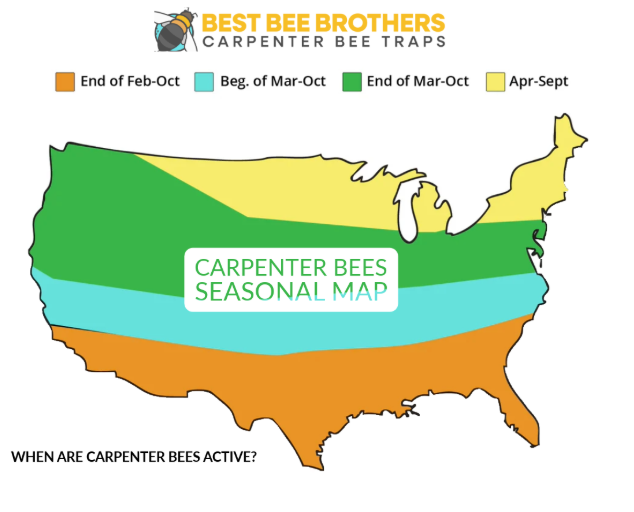
Orange Zone: Southern
Spanning southern California to South Carolina, this zone has the longest carpenter bee season (February–October) due to consistently warm weather. Prime breeding conditions increase infestation risk. Common species include the California Carpenter Bee (Xylocopa californica) and Valley Carpenter Bee (Xylocopa varipuncta). Affected states include southern California, Arizona, New Mexico, Texas, Georgia, Alabama, Florida, and South Carolina. Begin prevention in January before the season starts.
Blue Zone: South Central
The season runs March–October. Start prevention in mid-February. This region includes areas from Virginia and North Carolina through Tennessee, Missouri, Kentucky, Kansas, and west to Nevada and central California. Common species include Southern (Xylocopa micans), Eastern (Xylocopa virginica), and California carpenter bees.
Green Zone: North Central
The season lasts from March–October. States include Ohio, Illinois, Indiana, northern California, Washington, Idaho, and Oregon. The primary species is the Eastern Carpenter Bee (Xylocopa virginica). Begin prevention in late February or early March.
Yellow Zone: Northern
The shortest season runs late March–October. This zone includes Maine, Minnesota, New Hampshire, New York, and Wisconsin. The Eastern Carpenter Bee is most common. Install traps in late February or early March.
Carpenter bees can damage structural wood. Early prevention and monitoring help protect your home and outdoor structures.